


Thank you for Subscribing to Med Tech Business Review Weekly Brief


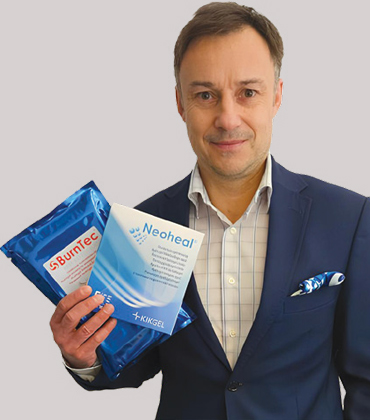 Piotr Kik, General Manager
For over three decades, Kikgel has focused on producing sterile hydrogel dressings at scale, under strict regulatory control, with reliability as the governing priority.
What makes Kikgel’s approach to wound care different from others in the industry?
That discipline emerged from a central question. How to engineer a dressing that soothes instantly, adapts to the body, never sticks to the wound and still holds nearly 90 percent water without collapsing?
Kikgel began answering that question long before moist-wound therapy became standard practice.
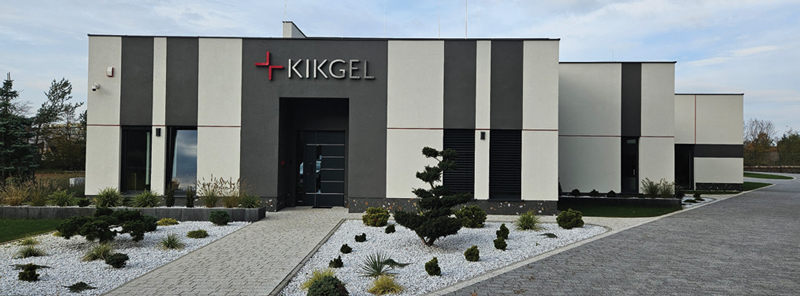
A pioneer among European manufacturers, it supplies clinically-proven hydrogel dressings to healthcare systems, emergency responders and surgical specialists. The dressings support moist wound healing while preserving structure, sterility and patient comfort.
“Our focus has always been on producing hydrogel dressings that are both clinically effective and reliably manufactured,” says Piotr Kik, general manager.
Kikgel’s hydrogel dressings play a central role in the treatment of first and second-degree burns, where no alternative offers comparable moisturization and soothing effects. They also support autolytic wound debridement and function alongside therapies such as hypochlorite and silver dressings that require a moist environment to maintain activity. An aqueous environment promotes enzymatic function and growth factor activity, supporting natural healing processes. Over the years, thousands of burns and ulcers have been treated using Kikgel’s hydrogel solutions.
What types of wounds are Kikgel’s hydrogel dressings particularly effective for?
The technology behind Kikgel’s hydrogel dressings is distinctive. Polymers cross-linked under electron beam exposure retain strength and absorption despite high water content. They are cooling, oxygen-permeable but bacteria-resistant, and non-adherent for painless removal. They are fully biocompatible and contour to the body perfectly.
Turning Early Hydrogel Science into a Clinical Standard Kikgel’s roots trace back to the 1990s, when radiation-based methods for producing hydrogel dressings were first developed at the Lodz University of Technology. As graduates of the same institution, Kikgel’s founders made an agreement with the university to translate academic research into industrial production.
-
Our focus has always been on producing hydrogel dressings that are both clinically effective and reliably manufactured. That balance allows our products to perform consistently across routine care and emergency settings.
Educating physicians and nurses about moist wound treatment was difficult due to early skepticism, but the team persisted. Today, the method’s proven effectiveness affirms their early conviction.
The portfolio has expanded steadily to meet diverse clinical needs. Beginning as a single Aqua-Gel and Neoheal dressing, it evolved into BurnTec for emergency care, HydroAid for plastic surgery and aesthetic medicine, and the Swiss Therapy Eye Mask for postoperative recovery following blepharoplasty. Kikgel also developed sterile hydrogel spacers that enable ultrasound examinations on wounds and superficial tissues, including Doppler imaging in emergency settings.
How has Kikgel’s product portfolio evolved over the years?
Operational reliability has supported international trust. Kikgel is a recognized leader in Poland and has established a growing global footprint. BurnTec dressings are supplied to the U.S. through North American Rescue for inclusion in IFAK first-aid kits and emergency medical supplies, while sterile hydrogel spacers are delivered to Japan.
Manufacturing Discipline as a Foundation of Trust
From the outset, Kikgel built its operations around structured quality systems. It operates in accordance with ISO 13485 to meet the stringent requirements of medical device manufacturing. Kikgel products carry the CE mark and hold FDA registration, reinforcing compliance across global regulatory environments.
The company has recently commissioned a new production facility featuring ISO 7 class cleanrooms. Every production stage undergoes validation and continuous monitoring to ensure safety and repeatability. Sterilization is conducted at the Institute of Nuclear Chemistry and Technology in Warsaw, a nuclear-certified partner selected to eliminate variability and internal risk.
Kikgel continues to balance innovation with controlled growth. Over the past five years, hydrogel dressing production has doubled to one million units annually, with exports accounting for 30 percent of output. Plans are underway to reach two million units in the coming years, driven by international expansion. New utility models, including perforated dressings and specialized shapes for emergency medical services, are already in development.
What are Kikgel’s future plans for growth and innovation?
Built on research, governance and manufacturing discipline, Kikgel advances sterile hydrogel solutions that clinicians and procurement teams can rely on when conditions are most demanding.
Evaluating Sterile Hydrogel Dressings for Modern Wound Care
Sterile hydrogel dressings have become a central component of contemporary wound management, particularly in burn care, chronic ulcers and procedures that require a controlled moist environment. For executives responsible for sourcing wound care products, the decision extends beyond unit cost or distribution scale. It hinges on clinical consistency, regulatory assurance and the underlying production technology that determines whether a dressing performs reliably across diverse care settings.
Moist wound therapy is no longer debated. Clinical practice recognizes that an aqueous environment supports enzymatic activity, facilitates autolytic debridement and promotes the function of growth factors essential to healing. Hydrogel dressings are frequently used for first- and second-degree burns due to their cooling effect and ability to maintain hydration without adhering to the wound bed. They also support combination therapies, including applications that depend on moisture to maintain antimicrobial activity. The practical implication for buyers is clear: the dressing must maintain structural integrity while delivering sustained hydration.
Manufacturing discipline has become a decisive differentiator. Healthcare providers require evidence that sterility is not assumed but validated, and that production processes are monitored under recognized standards. Compliance with ISO 9001 and ISO 13485, CE marking and FDA registration are baseline expectations in many markets. Cleanroom classifications, validated production stages and certified sterilization partners contribute to confidence that product performance will be repeatable. Procurement leaders evaluating suppliers should look for traceable controls and documented validation rather than generic assurances of quality.
Technology at the material level also influences outcomes. Traditional amorphous hydrogels can lack homogeneity or mechanical stability, creating handling challenges and variability in clinical use. Advanced polymer cross-linking methods can allow dressings to retain high water content while maintaining form, absorption capacity and tensile strength. Oxygen permeability combined with a barrier to bacteria, non-adherence to the wound surface and biocompatibility affect both healing trajectories and patient comfort. Products that adapt closely to body contours and allow painless removal reduce trauma during dressing changes, an important consideration in burn units and surgical aftercare.
Product portfolio breadth further signals strategic capability. Hydrogel technology that extends beyond general wound care into emergency burn applications, aesthetic and plastic surgery, ophthalmic recovery or sterile ultrasound spacers demonstrates versatility grounded in a single materials platform. Such extensions suggest that the manufacturer understands both clinical nuance and regulatory boundaries across use cases. Scalable production capacity and export track record add another layer of assurance for buyers managing multi-site or cross-border procurement.
KIKGEL represents a mature example of this profile. Its hydrogel technology originates from research developed at the Lodz University of Technology and relies on electron-beam cross-linking of polymers, enabling dressings that retain roughly 90 percent water while maintaining mechanical strength and absorption capacity. It operates under ISO 9001 and ISO 13485, holds CE marking and FDA registration and produces within ISO 7 cleanroom facilities, while sterilization is conducted at a certified nuclear chemistry institute. Its portfolio spans Aqua-Gel and Neoheal wound dressings, BurnTec for emergency use, HydroAid for plastic surgery, specialized eye masks and sterile ultrasound spacers. Production has doubled in five years to approximately one million units annually, with expansion plans tied to export growth. For executives prioritizing validated manufacturing, distinctive hydrogel technology and application breadth, it stands out as a disciplined and credible choice.
...Read more
